Open llms.txtCopy tools
Taxi Zone Feature Checks
Bottom Line
This benchmark checks whether CartoBoost can express taxi-lane feature families: sparse lane membership, route midpoint geometry, periodic hour, and combined geotemporal effects. It is deterministic feature acceptance, not a model comparison against external baselines.
Reproduce
uv run python scripts/run_lane_level_acceptance_metrics.py \
  --output-dir docs/assets/lane_level_tests
Artifacts:
docs/assets/lane_level_tests/acceptance_metrics.jsondocs/assets/lane_level_tests/acceptance_metrics.mddocs/assets/lane_level_tests/lane_heatmap.pngdocs/assets/lane_level_tests/hour_profile.pngdocs/assets/lane_level_tests/route_midpoint_geometry.png
Results
| Feature check | Main result | Outcome |
|---|---|---|
| Sparse lane membership | Sparse lane RMSE 0.0; axis lane-ID RMSE 51.96 | Passed: exact sparse lane fit. |
| Hot lane isolation | Hot lane margin 240.0 | Passed: margin > 200. |
| Route midpoint cartometry | Gaussian midpoint RMSE 0.0; axis midpoint RMSE 69.40 | Passed: Gaussian route RMSE < half axis baseline. |
| Periodic hour wraparound | Periodic hour RMSE ~0; axis hour RMSE 31.58 | Passed: 23:00 and 01:00 edge gap 0.0. |
| Combined lane/spatial/temporal | Holdout RMSE drops from 12.68 to 4.86 | Passed: full model / axis ratio 0.383. |
Plots
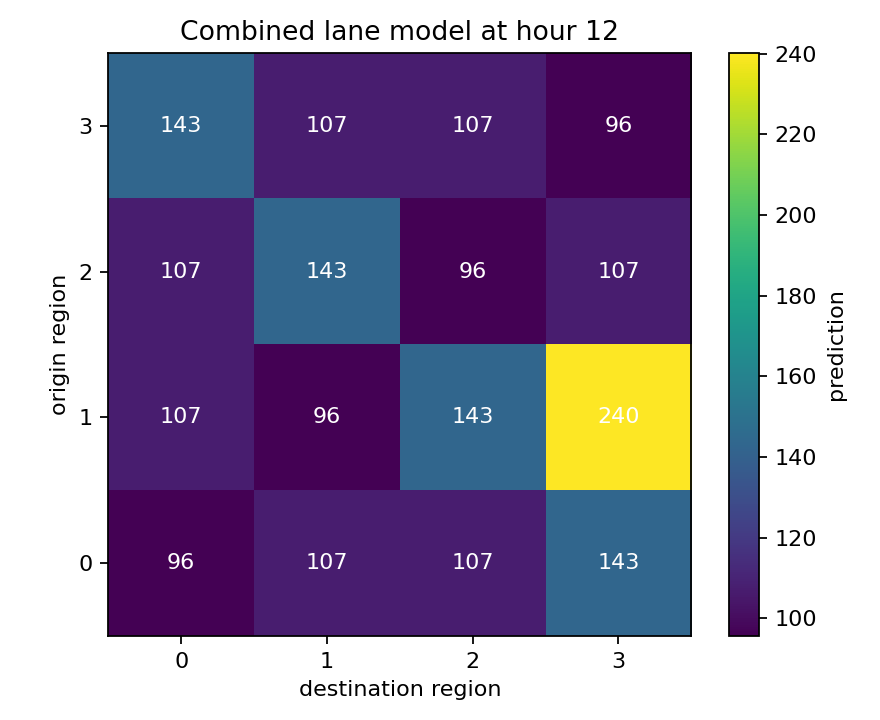
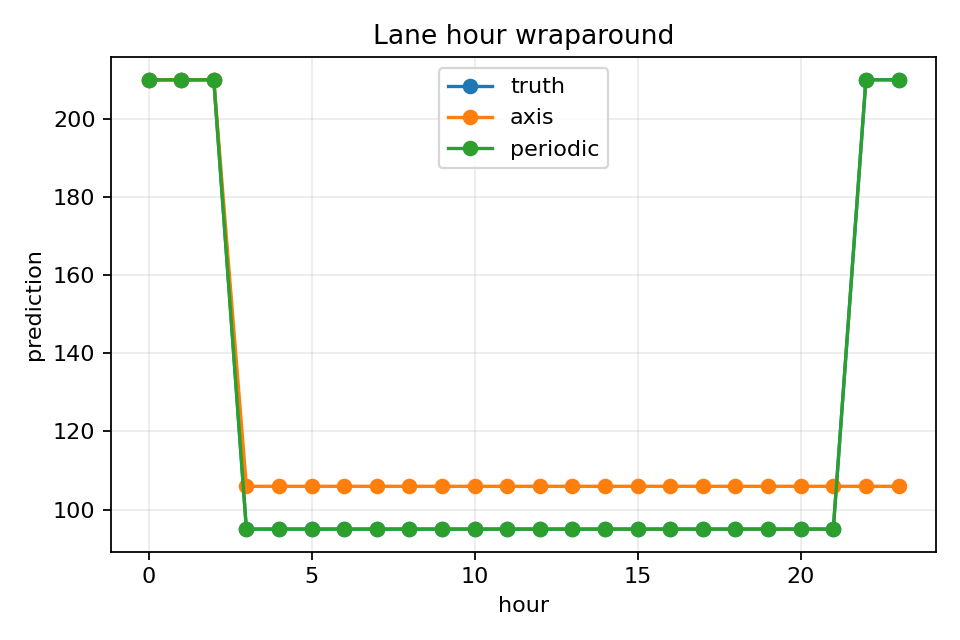
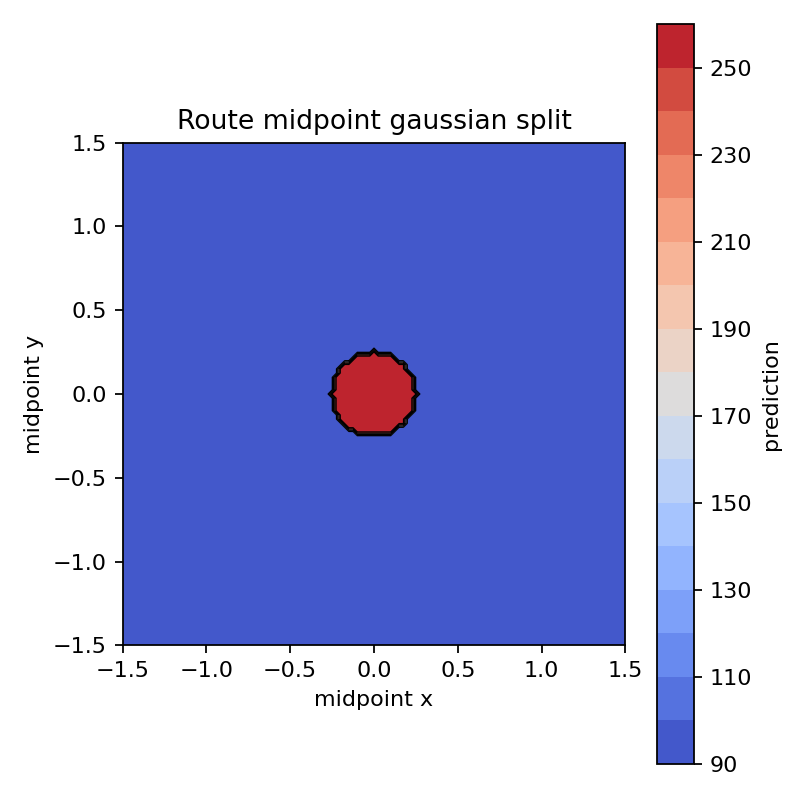
Interpretation
These results show that the implementation can represent each targeted feature family on a controlled taxi-lane fixture. They are useful for diagnosing model behavior before running a real-data benchmark.
Passing does not mean CartoBoost is more accurate than LightGBM, XGBoost, or a forecasting library on real data.